Experts check AI-built 3D anatomy before it reaches users.
AIRADAR Labeling is a reading platform where experts check, structure by structure, the 3D anatomical models that AI builds from CT scans before they reach users, and turn that check into measurable data.
All videos
They all play on this page; no files to send, just share the link to this page.
The problem: models are built fast, their errors go unseen
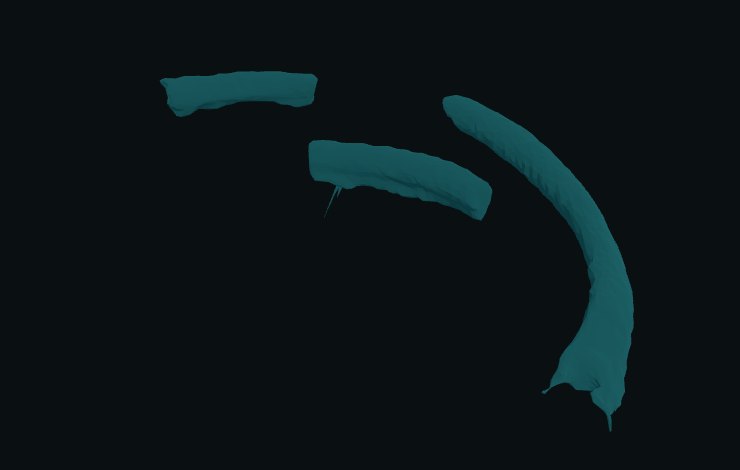
AI separates 80+ structures from a chest CT in minutes, and each becomes a 3D model.
A broken rib, holes, merged neighbours, numbering drift, a field-of-view cut. In the example the left 7th rib is in three pieces.
They change a few voxels and barely show on slices or in overlap scores. Yet users look at the model, not at slices.
The solution: before a model reaches users, an expert reads the delivered model with the CT beside it. Every judgement is a label on a named structure: countable data, not free-text comments. See the eight error types with examples →
What is new: six things that set it apart
The 3D model users get is reviewed, not the voxel mask. The CT is always beside it, and a click on the model is shown on the slices.
Eight error types per structure, each on a key, with confidence and a note. English and Turkish, machine-readable.
Blinding is enforced on the server: calibration first, then independent reads, repeat reads, consensus and a data lock.
The pipeline's own QC travels with the case but is hidden from readers; it is compared with consensus later and does not steer them.
A case opens in 3D Slicer with one click; corrections are made on the segmentation and saved as a separate version.
Inside the portal that serves the models. Per-project roles, a 20-language interface, outside experts join by invitation link.
Benefit: who gains, and how
Models students see in the 3D atlas and in XR have passed expert review, so wrong anatomy is not taught.
Inter- and intra-reader agreement per error type becomes measurable. Case files are recorded with checksums; the data is traceable and publishable.
We see which defect occurs in which structure and how often. Corrected segmentations become new training data.
Readers from different centres work to the same protocol from where they are. Each sees only what their role allows.
In short: instead of “the model looks fine”, we can say how many experts found which error, and how well they agreed.
How it works: seven steps
The card on the project page always names the one next thing to do. Readers never see each other's decisions; after consensus the data is locked. Project set-up guide →
Where it stands
Project set-up, invitations, reading, progress, messages and the 3D Slicer link are in use.
200 open-data cases; a radiologist reads first. More readers join as the protocol settles.
No patient data: open datasets and our own imaging.
Ready-made pitch
Use these when you describe the project to someone or in an e-mail. Pick a language and copy.
Etiketleme, yapay zekânın tomografiden ürettiği 3B anatomik modelleri kullanıcıya ulaşmadan önce uzmanların yapı yapı denetlediği ve bu denetimi ölçülebilir veriye çeviren bir okuma platformudur.
Yapay zekâ bir tomografiden dakikalar içinde onlarca yapıyı ayırıp 3B modele dönüştürebiliyor. Ancak bu dönüşümde kopuk kaburga, delikli yüzey, yanlış numaralanmış omur gibi hatalar çıkıyor ve bunlar kesitlerde ya da örtüşme skorlarında neredeyse görünmüyor. Etiketleme, uzmanı teslim edilen modelin karşısına, tomografiyle yan yana oturtuyor ve her hatayı adı belli bir yapıya bağlı, sekiz türlük ortak bir sözlükle kaydediyor. Körleme, kalibrasyon, tekrar okuma ve uzlaşıyla yürüyen bu okuma çalışmasının sonunda hem denetlenmiş modeller hem de okuyucu uyumu ölçülmüş, yayına hazır bir hata veri seti çıkıyor. Bu; eğitimde güvenilir 3B anatomi, araştırmada ölçülebilir kalite, yapay zekâ geliştirmede yeni eğitim verisi demek.
AIRADAR Labeling is a reading platform where experts check, structure by structure, the 3D anatomical models that AI builds from CT scans before they reach users, and turn that check into measurable data.
AI can now separate dozens of structures from a CT scan in minutes and turn them into 3D models. But that step brings its own errors (a broken rib, a surface full of holes, a vertebra with the wrong number) and they are almost invisible on slices and in overlap scores. AIRADAR Labeling puts the expert in front of the delivered model, with the CT beside it, and records every error on a named structure with a shared eight-type vocabulary. The reading runs as a study, with blinding, calibration, repeat reads and consensus. What comes out is a set of checked models and a publishable error dataset with measured reader agreement. That means trustworthy 3D anatomy in education, measurable quality in research, and new training data for AI development.
Common questions
Aren't overlap scores (Dice etc.) enough?
They are the right measures for the mask. But defects that change the model's shape (a break, a hole, a wrong number) involve a few voxels and barely move the score. Since users see the model, it needs its own check.
Why not do it all in 3D Slicer?
Slicer is a powerful viewing and editing tool, but not the infrastructure of a reading study: no assignments, blinding, calibration, repeat reads, consensus or data lock. The platform joins the two: reading and records on the platform, corrections in Slicer.
How is it different from general labeling tools?
General tools mostly focus on drawing masks or boxes on images. This platform focuses on structure-level review of the finished 3D model, a shared error vocabulary and a reading-study protocol.
Who can take part?
The project owner creates an invitation link; the invited person sets their own password and enters only that project, as far as their role allows. The rest of the portal stays closed to that account.